
Types of Aided Augmentative and Alternative Communication
There are a wide range of aided AAC available to choose from. Some examples are communication books, speech generating devices, choice boards, core boards, PECs, PODD books, alphabet charts, keyboards, and AAC apps for iPads, tablets, and phones.
When supporting language development, it is important to include a robust language system. A robust language system includes access to letters, nouns, adjectives, and verbs as well as symbols or phrases for requesting, greeting, protesting, commenting and questioning.
Aided language simulation is a strategy to use when teaching an individual who uses AAC. It is where you point to the individual's AAC system as you speak and you "show as you go." The resources, descriptions, and pictures below are just a few examples of aided AAC available to you and your students.
Low Tech AAC
Low Tech(nology) AAC are communication resources that do not involve technology or electronics in any way. They are often presented in paper forms such as communication or core boards, Picture Exchange Communication Systems (PECS), PODD books, alphabet boards/keyboards and communication flip books. Some low-tech communication boards are in the same format as the high-tech speech generating devices. This can be a great starting point for individuals learning AAC with the intent of potentially using a speech generating device in the future. The user communicates using these systems by pointing to the image or phrase that represents the idea they want to communicate.
These low-tech systems are explained in greater detail below.


High Tech AAC
High Tech AAC are communication resources that have an element of technology to them. Some examples of high tech AAC are speech generating devices, voice output communication aids, iPads, and GoTalks.
High Tech AAC has many benefits. The AAC user can be understood by their communication partners, their device is portal and often lightweight, and it is able to be personalized to language used by the individual. AAC provides a dependable way for individuals to improve their communication skills, connect with others, and reduce a sense of isolation from the wold around them.
According to Millar, Light, and Schlosser's 2006 research review on the impact of AAC intervention on the speech production on individuals who have developmental disabilities, 89% of the participants improved their speech after having AAC intervention.
Core Boards
Core boards are pages made up of the words that are most frequently used in one's language. Approximately 80% of the words we say are made up of around just 250-500 words.
Core boards are formatted and colour coded into different sections for nouns, verbs, questions, adjectives etc. Each brand of core board represents language in a slightly different way. Some examples of Core boards can be found below:


Fringe Vocabulary
Fringe vocabulary is the language we use approximately 20% of the time. It includes nouns such as 'playground,' 'mom,' or 'tree.' These words are specific to a specific subject and their meaning cannot to be transferred to a variety of situations.
Fringe vocabulary can be easily represented in images with its literal context. Fringe vocabulary can be added to a low-tech communication book easily through websites such as www.lessonpix.com
Images created on www.lessonpix.com
LAMP Words for Life
LAMP™ stands for Language Acquisition through Motor Planning. The device was developed for those who are beginning to develop their language skills to those who have advanced language skills. Through the motor planning aspect of their device and app, LAMP can "enable early success and allow the client’s vocabulary and communication skills to grow in a way that doesn’t require re-learning along the way. Because this is a pre-programmed vocabulary program, Words for Life doesn’t require extensive customization" (https://lampwflapp.com/)
LAMP WFL is available as a downloadable app or on a designated speech generating device.
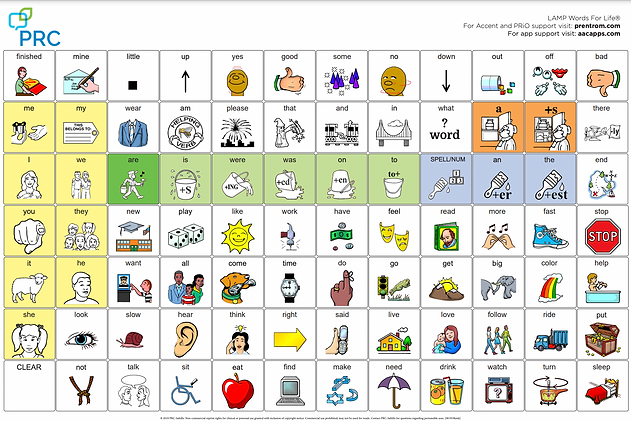
Image collected from https://aaclanguagelab.com/resources/lamp-words-for-life-manual-boards

Saltillo Wordpower Apps and Flip Books
Flip books are made of a core board with attached fringe vocabulary which are described in further detail above. The flip books here are the low tech version of apps and SGD. Having a low tech version of an SGD is beneficial for when the student is ready to transition to a high tech device. It is also helpful to know how to use a flip book incase the battery dies on the students' SGD or it needs to go in for repair.
Some examples of Core boards and flip books can be found below:
Image collected from https://saltillo.com/chatcorner/content/29
ProLoQuo2Go
ProLoQuo2Go is an aided AAC app made by AssistiveWare. The company has made low-tech versions of the app into core boards and flip books to allow the user to transition between high-tech and low-tech.
When trying to decide on which app is best suited for your AAC user, AssistiveWare's website brings you through a short questionnaire of some simple questions, such as:
- Are you looking for an AAC system for any of the following languages?
- Does the AAC user know how to spell and read?
- Does the AAC user prefer typing or pressing buttons with symbols?
- Are you looking for an English only AAC app or one that supports multiple languages?
- In terms of vision and physical skills, is the AAC user able to select the app(s) they want to open on the iPad home screen independently?
- Are you familiar with and have support to use the PODD system?

Image collected from https://www.assistiveware.com/blog/new-to-proloquo2go-training

Image collected from https://www.attainmentcompany.com/gotalk-20
GoTalk Products
GoTalk is a company that creates battery powered AAC devices. The majority of their products are gird based machines that have a row of buttons that are consistent between layers that focus on one's core or primary language. Some of the products created are the GoTalk 1, GoTalk 4+, GoTalk 9+, GoTalk20+, GoTalk 32+, the GoTalk Select, and the GoTalk Button. The numbers in these products represent the number of cells outside of the core language which are programmable. The devices are sturdy. lightweight and have a handle which helps make them portable. They have 5 layers which are editable and the audio can be recorded. Editable and pre-made inserts for the language layers can be made on websites such as on LessonPix and TeachersPayTeachers and templates can be found on Board Maker and SET BC's website.
PODD Books and Devices
Empower
Growth
PODD are books and devices that use visuals paired with words to support communication for those with complex communication needs.
A PODD stands for:
-
Pragmatic – the ways that we use language purposefully and socially
-
Organization – the systematic way that the words and symbols are arranged
-
Dynamic Display – vocabulary and range of statements are supported by changing pages
PODD is designed to give individuals access to a large vocabulary of words. PODD was created with a focus on a range of ways to communicate, including requests, questions, comments, greetings, opinions and more!
PODD comes in a wide variety of formats that support a range of needs such as eye gaze, cortical visual impairment books, PODD books, electronic PODD with voice output, and combination access.
Learn more about PODD in the link below:


Image collected from https://pecsusa.com/shop/communication-book/#tab-description
PECS
PECS stands for The Picture Exchange Communication System®. The system is designed for an individual with limited verbal communication skills to use pictures to communicate by exchanging the image for the item they want or need.
Learning how to communicate using PECS is broken down into 6 phases:
Phase I: requesting - single picture exchanges for preferred items or activities
Phase 2: Distance and Persistence - single picture exchanges in in different places, with different people
Phase 3: Picture Discrimination - will select preferred item from two or more pictures and are placed in a communication book
Phase 4: Sentence Structure - requesting using "I want" sentence structure
Phase 5: Answering Questions - responding to "What do you want?"
Phase 6: Commenting - responding to questions and making up sentences such as "I see" or "I feel"
Learn more about PECS on these websites:
Some PECS resources can be found on these websites: